


























Views
Downloads

Printable Patterns of the Sun Worksheet | Grade 1 Science
Paste this activity's link or code into your existing LMS (Google Classroom, Canvas, Teams, Schoology, Moodle, etc.).
Students can open and work on the activity right away, with no student login required.
You'll still be able to track student progress and results from your teacher account.
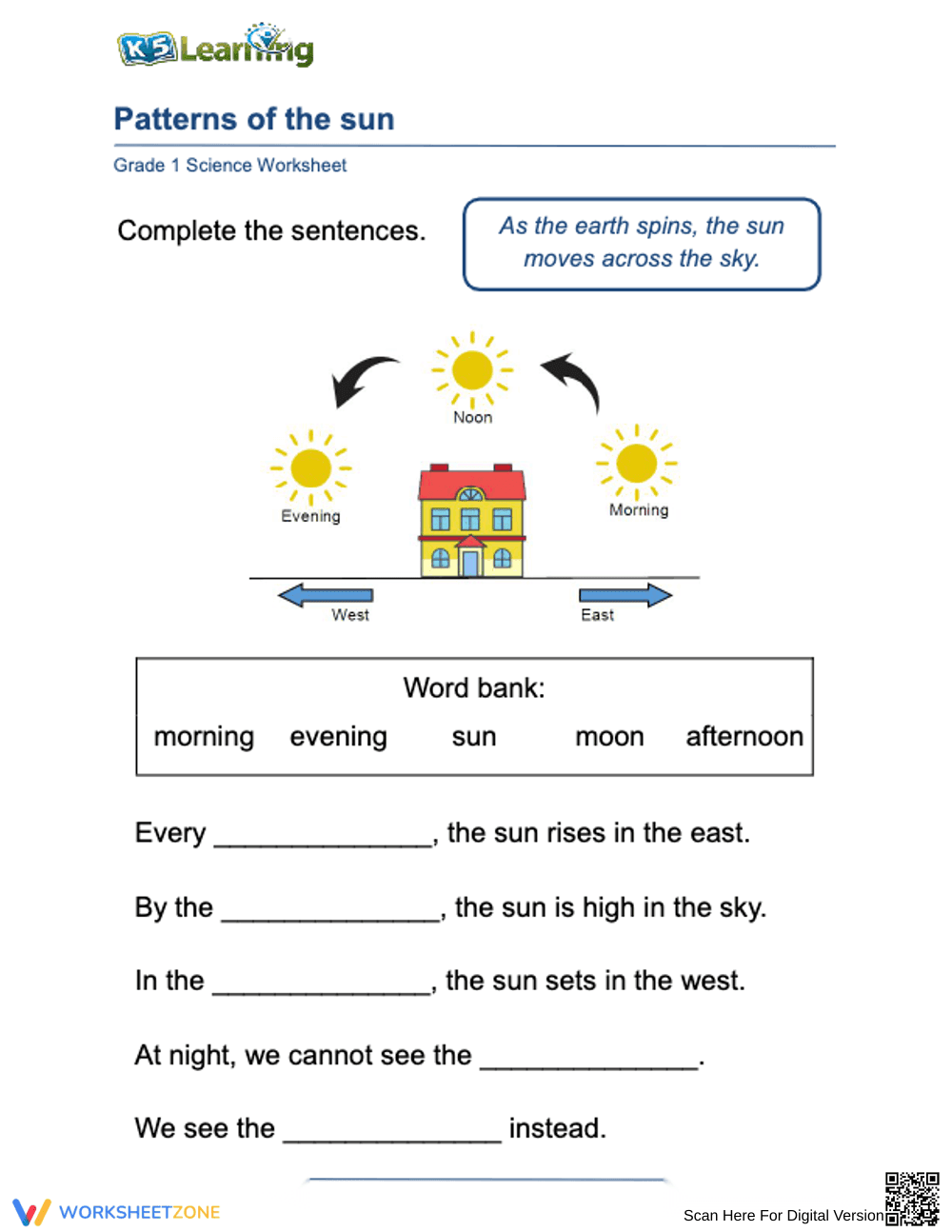
This Grade 1 science worksheet helps young learners identify and describe the observable patterns of the sun throughout the day. By connecting visual diagrams with sentence completion tasks, students develop a foundational understanding of how the sun appears to move as the Earth spins. It is an essential tool for early astronomy and Earth science units.
At a Glance
- Grade: 1 · Subject: Science
- Standard:
1-ESS1-1— Use observations of the sun to describe patterns that can be predicted- Skill Focus: Solar Patterns & Daily Cycles
- Format: 2 pages · 5 problems · Answer key included · PDF
- Best For: Independent practice and quick formative assessment
- Time: 10–15 minutes
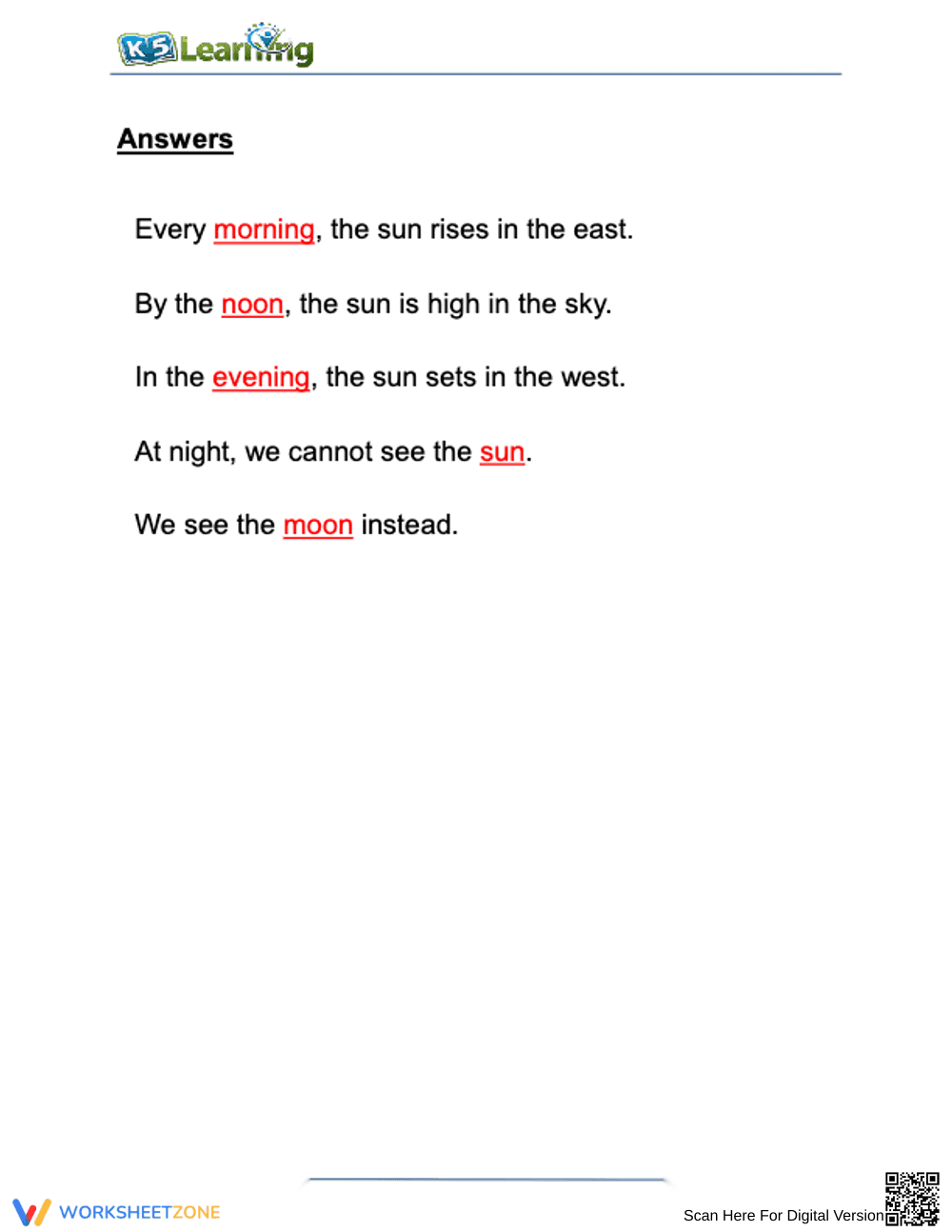
The resource consists of a single-page student activity and a corresponding answer key for rapid grading. It features a clear, labeled diagram illustrating the sun's position at morning, noon, and evening relative to a house. Students use a structured word bank containing five key terms—morning, evening, sun, moon, and afternoon—to complete sentences that describe solar movement and the transition to night.
Implementing this activity requires minimal effort, making it ideal for busy classrooms or substitute plans. First, print the single student page in under 30 seconds. Next, distribute the sheets to students for a quick 10-minute independent session. Finally, use the provided answer key to review the concepts as a whole class or for individual grading in less than 1 minute. This streamlined process ensures that instructional time remains focused on student learning rather than administrative setup.
This worksheet is explicitly aligned to `1-ESS1-1`, which requires students to use observations of the sun, moon, and stars to describe patterns that can be predicted. It specifically targets the Earth's Place in the Universe disciplinary core idea. Both standard codes can be copied directly into lesson plans, IEP goals, or district curriculum mapping tools.
Use this worksheet as a closing activity after an outdoor observation session where students track the sun's position. It serves as an excellent formative assessment to check if students can translate real-world observations into written descriptions. Teachers can observe students during the word bank selection process to identify those who may need additional scaffolding with directional vocabulary like "east" and "west."
Designed primarily for first-grade students, this resource is also suitable for kindergarten extension or second-grade review. The visual supports and word bank make it accessible for English Language Learners and students with IEPs. It pairs naturally with a short informational passage about the Earth's rotation or a classroom anchor chart showing the daily solar cycle.
The predictable patterns of celestial bodies form the bedrock of early scientific inquiry and spatial reasoning. This resource facilitates the mastery of the `1-ESS1-1` standard by requiring students to verbalize the observable sun patterns they see daily. According to a ScienceDirect TpT Analysis, high-quality visual scaffolds in early science education significantly improve a student's ability to retain complex concepts such as the Earth's rotation and its effects on the solar cycle. By engaging with these 5 tasks, students transition from simple observation to predictive modeling, a key shift in early childhood cognitive development. The inclusion of an answer key ensures that feedback is immediate and accurate, which is critical for correcting misconceptions about the sun's physical movement versus the Earth's spin. This worksheet provides a robust framework for documenting student progress toward state and national science benchmarks.


